
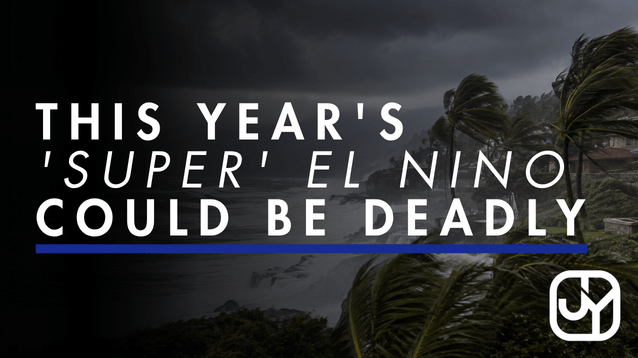
Why This Year’s “Super” El Nino Can Be Deadly (UPDATE)

Update September 21, 2026: Governor Gavin Newsom has declared a state of emergency for California, enabling preparation for an intense El Niño event. By declaring a state of emergency, Newsom allows state agencies like Caltrans, along with the National Guard, to prep safeguards against flood destruction.
According to KTLA News, the governor’s office said, “Caltrans will stage traffic-control, road-closure, and snow-removal equipment along the highways most at risk. The proclamation also prepares the California National Guard to support flood response, search-and-rescue, engineering, and logistics missions when needed. State environmental and natural resources agencies will support local efforts to prepare for flooding, landslides, and debris flows, by fast-tracking permitting and identifying other ways to cut red tape.”
Federal forecasters say the El Niño now building in the Pacific Ocean has a better-than-90% chance of reaching “very strong” strength by winter, and a 69% chance of surpassing every El Niño on record dating back to 1950.
For California, the forecast carries a public safety warning as much as a weather one: flash floods, mudslides on wildfire burn scars, record coastal flooding and a sharp rise in wet-road collisions across the state’s freeways and surface streets.”
What El Niño Might Look Like in 2026
The National Oceanic and Atmospheric Administration’s Climate Prediction Center issued the update Thursday, ranking the current event as the second-strongest on record for this point in the year, trailing only 1997. NOAA scientist Michelle L’Heureux said the agency’s confidence in a very strong El Niño “is the highest chance to date,” though she cautioned that not every region will see the textbook effects even in a historic year, since seasonal forecasts are expressed as probabilities rather than guarantees.
El Niño is the warm phase of a natural Pacific Ocean cycle that shifts storm tracks, jet stream position and rainfall patterns across North America roughly every three to seven years. During strong events, a stronger subtropical jet stream pushes Pacific storms and atmospheric rivers directly into Southern California, increasing odds of a wet, stormy winter along the state’s southern tier.
University of California climate scientist Daniel Swain called the current event “a genuinely remarkable” one, noting conditions are already at record-tying territory in August and are expected to intensify further before the peak.
This El Niño is developing on top of a climate system that is already unusually warm, which amplifies its downstream effects. NOAA projects a 99.9% chance that 2026 ranks among the five warmest years on record, and El Niño’s own warming signal tends to ride on top of that longer-term trend rather than replace it. The last comparably strong event, in 2023, was followed by 2024 becoming the planet’s warmest year on record.
For a free legal consultation, call (877) 735-7035
El Niño’s history of flood damage and debris flows
California’s two prior comparably strong El Niño weather events illustrate the range of outcomes. The 1997-98 event brought roughly $550 million in flood and mudslide damage statewide and 17 deaths, with downtown Los Angeles recording nearly a year’s worth of rain in a single month. The 2015-16 event, by contrast, reached similar ocean temperatures but delivered below-average rainfall to Southern California, a reminder that strength alone does not guarantee flooding in any one location.
Southern California’s added risk this year comes from its wildfire burn scars. Hillsides stripped of vegetation by recent fires cannot absorb water at normal rates, allowing storm runoff to carry mud, rock and debris downhill at high speed during intense rainfall. State fire and emergency officials have flagged flash flooding, and debris flows in burn areas as a leading concern heading into the wet season.
Scripps Institution of Oceanography climate scientist Mark Merrifield told a legislative town hall the state should expect the highest sea levels ever recorded on the California coast this winter. Thermal expansion of warmer ocean water is driving the rise, compounded by the storm surge, high surf and king tides typical of a strong El Niño.
Wet roads and rising crash risk
The clearest everyday hazard for most Californians will be on the road. According to the Federal Highway Administration’s Road Weather Management Program, 75% of weather-related vehicle crashes nationwide occur on wet pavement, and 47% happen during active rainfall, together killing nearly 5,700 people and injuring more than 544,700 annually. Rain reduces tire traction and visibility and cuts freeway speeds by roughly 3% to 17% during heavy downpours, conditions that become far more frequent across California during a strong El Niño winter.
Click to contact our personal injury lawyers today
How to protect yourself on wet and flooded roads
Simple maintenance and driving adjustments cut much of that risk:
- Check tire tread depth before the rainy season arrives and again periodically through winter. The legal minimum is 2/32 of an inch, but tires worn down to that point can take more than 100 additional feet to stop on wet pavement compared with new tires, according to tire industry testing cited by NHTSA-aligned safety researchers.
- Replace tires closer to 4/32 of an inch if they will see regular rain exposure. Deeper grooves channel water away from the tire and reduce the risk of hydroplaning, a hazard that becomes significantly more likely above roughly 35 mph on a wet surface.
- Replace windshield wiper blades roughly every six to twelve months, sooner if they streak, skip or squeak and no longer clear water effectively.
- Test defrosters and headlights before the first major storm, since reduced visibility is a factor in a large share of weather-related crashes.
- Never drive or walk into flood water. Water depth is nearly impossible to judge from inside a vehicle, and a road surface can be washed out or collapsed beneath standing water without any visible warning. According to the National Weather Service, just 6 inches of fast-moving water can knock over an adult, 12 inches can float and carry away most passenger cars, and 2 feet of moving water can sweep away SUVs and trucks.
- Turn around at a flooded road or barricade rather than attempt to cross it.
- Leave extra following distance around large trucks and motorcyclists in wet weather. A loaded tractor-trailer already needs roughly the length of two football fields to come to a complete stop from highway speed under good conditions, according to the Federal Motor Carrier Safety Administration, and that distance grows substantially on wet pavement.
- Give trucks and buses extra space when merging in front of them, and avoid lingering beside one where the driver’s visibility is limited. Never assume a fully loaded commercial vehicle can stop as quickly as a car.
- Slow down before a curve or exit rather than braking through it, since sudden braking on wet pavement is a leading cause of skids.
- Turn on headlights during rain, even in daylight. California Vehicle Code section 24400 requires headlights whenever windshield wipers are in continuous use because of rain, mist, snow or fog.
- Increase following distance on wet roads from the standard three seconds to five or six seconds, longer still in heavy rain or standing water.
Complete a Free Case Evaluation form now
What California law says about weather-related injuries
California law does not treat severe weather as an excuse for careless driving or unsafe property conditions. Under Civil Code section 1714, every person is responsible for injuries caused by a failure to use reasonable care, and that standard does not relax simply because a storm is underway. A driver who speeds on a flooded roadway, tailgates in heavy rain or ignores a posted flood advisory can be held liable for resulting injuries the same as a driver on a clear day.
Government entities carry additional exposure during storm season. Under Government Code section 835, a public entity can be held liable when a dangerous condition of public property, such as a clogged storm drain, an unmarked flooded underpass or a poorly maintained debris basin below a burn scar, causes injury and the entity had notice of the hazard and failed to address it. These claims are available only where a genuine roadway or infrastructure defect is established, and it comes with a hard procedural deadline: under Government Code section 911.2 and the Government Claims Act, an injured person generally has six months from the date of injury to file a claim against a public entity, far shorter than the two-year window under Code of Civil Procedure section 335.1 that applies to most private negligence claims.
That two-year standard applies whether the case proceeds as a personal injury claim or, because of a fatality, a wrongful death action under Code of Civil Procedure sections 377.60 and 377.61, brought on behalf of a surviving spouse, child or other statutory heir. A related survival action under Code of Civil Procedure section 377.30 allows a decedent’s estate to recover damages the person could have claimed had they lived, covering the period between injury and death.
Get Help After a Storm-Related Crash or Injury
Severe weather does not erase a driver’s or property owner’s duty to keep others safe. If you or a loved one was hurt in a flood-related crash, a mudslide or any other storm-related incident this El Niño season, J&Y Law can help.
J&Y Law represents injury victims across Los Angeles and the San Fernando Valley on a contingency-fee basis: you pay nothing upfront and owe no attorney fees unless we win. Our team identifies every liable party, including negligent drivers and public entities that failed to maintain safe roads, and fights for the compensation you deserve.
Call J&Y Law today for a free consultation. Claims against government entities carry a strict six-month deadline, so don’t wait to protect your rights.
Call or text (877) 735-7035 or complete a Free Case Evaluation form