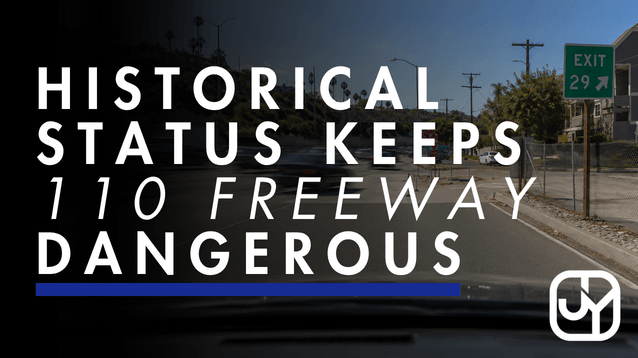
Why the 110 Freeway Is So Dangerous — and Why It Won’t Be Fixed Anytime Soon
The 110 Freeway is the oldest freeway in the country, and its age shows in the crash numbers. A Caltrans study of the corridor found a collision rate roughly double that of comparable highways, driven largely by a design that predates the modern freeway itself. Layered historic protections that shield the route from a full redesign mean the fix now on the books is narrow, and it won’t arrive before 2028.
The 110 Freeway’s Origins Connecting Los Angeles to Pasadena
The freeway began as the Arroyo Seco Parkway, which opened between Los Angeles and Pasadena on December 30, 1940, as the first freeway built in the western United States. Engineers designed it for a 45 mph cruising speed, with narrow lanes and tight, banked curves meant for the traffic volumes of the 1940s. The state has since posted the speed limit at 55 mph, but the roadway itself has barely changed. Its northern stretch, still known as the Arroyo Seco Parkway or the Pasadena Freeway, still runs through its original tunnels and tight curves, with short on-ramps that begin at stop signs instead of merging lanes.
A three-year Caltrans crash analysis of the freeway, conducted with the Federal Highway Administration, recorded 1,217 total crashes, including 324 involving the median barrier that resulted in 111 injuries and one fatality. Caltrans attributed the pattern to the gap between the road’s 1940s design and today’s driving speeds, concluding that the lack of acceleration and deceleration lanes forces drivers merging from a full stop directly into freeway-speed traffic. The agency found crashes concentrated around the corridor’s entrance and exit ramps, where that design flaw is most acute.
Independent traffic analysis backs up that reputation: a 2018 review by Crosstown, which tallied reported collisions across 24 Los Angeles freeway segments over a year, found the northbound 110 between San Pedro and the 101 recorded more crashes per mile than any other stretch of freeway in the city. The Arroyo Seco Parkway segments further north also ranked among the higher-crash corridors in the analysis. Drivers who use the parkway regularly describe merging onto it as one of the more unnerving parts of their daily commute, given the blind curves and runways that leave little room to build speed before joining traffic.
For a free legal consultation, call (877) 735-7035
Historic Protection That Prevents Safety Updates
The parkway carries multiple layers of historic protection: a 2011 listing on the National Register of Historic Places, a 1999 designation as a National Historic Civil Engineering Landmark, and status since 1993 as a California Historic Parkway under a state scenic highway program reserved for freeways built before 1945. Those designations are why Caltrans has pursued preservation instead of a full rebuild. There are no current plans to widen the road, add standard acceleration and deceleration lanes, or otherwise bring it up to modern interstate specifications.
Caltrans has detailed a considerably smaller-scope $43 million Arroyo Seco Parkway Upgrades Project targeting three specific structures: replacing the aging bridge connecting the northbound 110 to the northbound 5 near Elysian Park, and upgrading the railings on the Avenue 43 Ramp Bridge and the Arroyo Seco Channel Bridge with modern, crash-tested barriers. Construction is scheduled to begin in 2028 and finish by the end of 2029. The project addresses specific structural deficiencies rather than the ramp and merge geometry that Caltrans’s own crash data identifies as the corridor’s leading safety issue.
Accidents and Injuries on the 110 Freeway
For drivers hurt on the 110, California law offers more than one path toward accountability. A collision caused by another driver’s negligence can support a standard personal injury or wrongful death claim, whether that negligence involves unsafe merging or driving too fast for the roadway’s tight curves.
Where a dangerous condition of the roadway itself, such as an inadequate merge lane or a deficient bridge railing, contributes to a crash, California law also permits claims against the public entity responsible for maintaining that infrastructure under Government Code section 835. Those claims against government agencies carry a much shorter filing deadline than claims against private drivers.
Call or text (877) 735-7035 or complete a Free Case Evaluation form