Autonomous Delivery Robot Incidents and Legal Liability

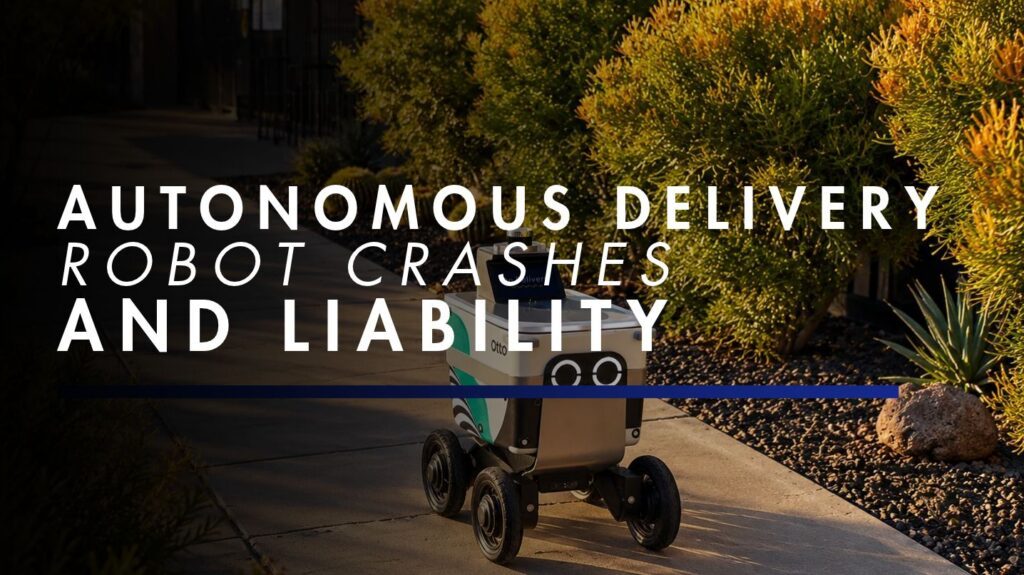
As autonomous delivery robots expand across university campuses and suburban streets, these six-wheeled rovers are sharing narrow pedestrian pathways with walkers, runners, and cyclists.
Weighing up to 100 pounds and operating at Level 4 autonomy, devices built by companies such as Starship Technologies and Serve Robotics rely on camera arrays, radar, and machine learning algorithms to navigate urban environments. However, as deployment scales, a growing number of collisions and near-misses reveals significant technical flaws and complex liability questions.
Critical Design Flaws and Navigation Failures
Despite marketing claims of physical AI efficiency, sidewalk delivery robots exhibit severe operational limitations. Key hardware and software vulnerabilities include signal misinterpretations, a lack of mechanical redundancy, and delayed intervention by remote human operators. These design flaws can cause robots to stall on critical transport infrastructure—such as a Coco Robotics unit that immobilized itself on active railroad tracks in Miami—or block vital sidewalk curb cuts required by mobility-device users.
Even more alarming are unpredictable motion failures. In a notable incident at Arizona State University, a Starship delivery rover suddenly reversed course without warning, striking a 73-year-old parking attendant, knocking her down, and causing severe spinal fractures and permanent physical impairment. Police logs confirmed there was no obstacle in front of the machine to trigger such a maneuver.
For a free legal consultation, call (877) 735-7035
Navigating Legal Liability for Injuries
When a sidewalk robot strikes a pedestrian or cyclist, determining legal responsibility involves intersecting theories of product liability and negligence. Injured parties can pursue claims against several potential defendants.
- Fleet Operators & Software Developers: For negligent deployment, inadequate real-time human monitoring, and algorithmic motion defects.
- Manufacturers: For design and manufacturing defects in sensor fusion, braking, or obstacle-avoidance systems.
State regulatory frameworks vary widely. For instance, Arizona law requires operators to maintain at least $100,000 in liability insurance per robot and mandates active human oversight.
Despite these legal protections, corporate responses to victims have drawn sharp criticism—such as offering food delivery promo codes to severe injury victims.
As these machines proliferate, establishing strict corporate accountability and rigorous safety standards remains essential to protecting public safety on shared walkways.
Call J&Y Law If You’ve Been Hurt
If you’ve been hurt by an autonomous delivery robot, we want to hear from you. Our attorneys have 80 years of combined experience fighting for the rights of injured victims. We make sure your recovery goes smoothly and that we’re always in touch when you need us. Call any time, 24/7, for a free consultation.
Call or text (877) 735-7035 or complete a Free Case Evaluation form