
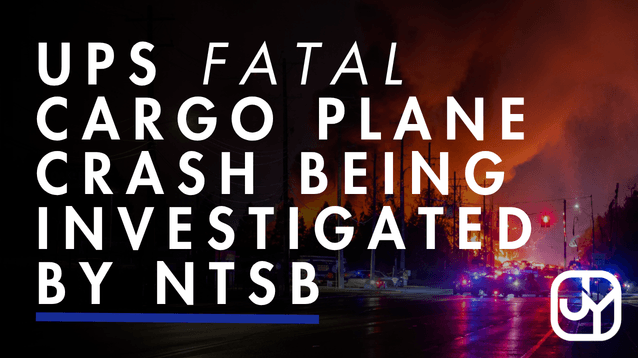
UPS Fatal Cargo Plane Crash Being Investigated by NTSB
Federal investigators are examining this week why an engine fell off a McDonnell Douglas MD-11 cargo jet at takeoff last November — and whether warnings going back to 2011 were ignored.
LOUISVILLE, KY (May 19, 2026) — Federal safety investigators are holding hearings Tuesday and Wednesday examining why an engine flew off a UPS cargo plane last year, causing a crash that killed 15 people, and why Boeing didn’t address the underlying flaw sooner. The National Transportation Safety Board’s proceedings come as a wave of civil litigation is already building against UPS, Boeing, and others who survivors say had every reason to prevent the disaster.
The timing matters for families and injury victims watching the hearings: what investigators uncover this week could directly shape the legal battles ahead.
If you or a loved one have been injured in an aviation accident, J&Y Law is available to you, 24/7, for free consultations.
The UPS Crash on November 4, 2025
The UPS jet — a McDonnell Douglas MD-11 — lost its left engine and pylon shortly after taking off from Louisville Muhammad Ali International Airport, crashing just seconds into the flight, according to the NTSB. The plane, which was headed for Hawaii loaded with packages and fuel, had barely left the ground and cleared the airport fence when it crashed into several nearby Louisville businesses and created a massive fireball.
Dramatic photos the NTSB released showed the engine detaching and flying up and over the wing as flames erupted. The final images show the plane ablaze as it gets airborne, leaving behind trails of smoke.
The engine separated from the MD-11’s wing as it accelerated down the runway, killing three pilots on the plane and 12 more people on the ground.
Exploding in a fireball, it slammed into a nearby scrapyard, Grade A Auto Parts & Recycling.
Ashley Muse, a worker there and now a plaintiff in one of the lawsuits, described the moment to ABC News. “All you could see was a huge ball of fire coming straight for us, and everyone started screaming and running, and within seconds, it hit us, the whole building shook like we were in an earthquake,” Muse said.
Among those killed on the ground was 3-year-old Kimberly Asa. Her autopsy showed she suffered from excessive smoke inhalation, soot in her airway, charring across her body, and heat-related fractures to her skull, left ribs, and both arms, according to lawsuit filings. Her cause of death was determined to be smoke inhalation and thermal injuries. Her grandfather Louisnes Fedon also perished while trying to escape with her.
“It’s not something that you hear about,” said Sherline Fedon, Kimberly’s mother and Louisnes’ daughter. “That’s something that you see on the news, and never think that you would be a part of it, or someone that you love to be a part of that.”
UPS Knew of the Problem, Years in the Making
The NTSB hearings this week are zeroing in on a question that is also at the heart of the pending civil lawsuits: why did a known structural vulnerability go unaddressed for so long?
The NTSB said shortly after the Louisville crash that investigators found cracks in some of the parts that held the engine to the wing — cracks that hadn’t been caught in regular maintenance. The last time those key engine mount parts were examined closely was October 2021, and the plane wasn’t due for another detailed inspection for roughly 7,000 more takeoffs and landings.
Boeing had documented in 2011 that there were four previous failures of a part that helps secure the MD-11’s engines to the wings on three different planes, but at that point the plane manufacturer determined it “would not result in a safety of flight condition.” The service bulletin Boeing issued didn’t require plane owners to make repairs like an FAA airworthiness directive would, and the agency never issued such a directive.
That 2011 document is now central to the lawsuits. The lawsuits allege it informed operators of the MD-11, including UPS, of the risk of bearing race failures — and yet Boeing “did not alter the inspection interval for MD-11 spherical bearings and bearing races.” The lawsuits further allege Boeing “failed to provide adequate warning of the defective condition of the MD-11 and failed to provide a reasonably safer alternative.”
15 Lawsuits, More Than 100 Plaintiffs
A total of 15 civil lawsuits were filed in Jefferson Circuit Court on behalf of more than 100 survivors, victims, and impacted businesses. The complaints name a lengthy list of defendants, including UPS, Boeing, GE, Allianz insurance, and the company that performed maintenance and repair on the plane.
Also named is the estate of the flight’s captain. The lawsuits allege that upon takeoff roll and rotation, a “repeated bell was sounding in the cockpit” but Capt. Richard Wartenburg “failed to act appropriately when presented with this alarm bell and failed to prevent the crash.”
Attorney Masten Childers III, representing the plaintiffs, was blunt. “People made decisions, corporations made decisions, to continue to operate these planes,” Childers said. “More could have and should have been done to ensure that those problems were remedied so things like what happened on the 4th didn’t happen.”
The lawsuits allege that UPS and the other defendants “accepted the risk of an MD-11 crash by continuing to utilize the aircraft type without more frequent and rigorous inspections of the pylon assemblies” — and that the cost of such inspections would have made the plane model “inefficient for operation from a cost perspective.” In other words, plaintiffs allege, cost considerations took priority over passenger and bystander safety.
Where the NTSB Stands Now
The NTSB’s final report likely won’t be ready until more than a year after the crash, as the agency examines everything that might have contributed to the disaster.
Some MD-11s are now back in the air after the FAA approved Boeing’s plan to replace the spherical bearing on each aircraft and increase inspections. FedEx resumed using the planes on May 10, but UPS has said it plans to retire its fleet of MD-11s. Western Global also operates MD-11s but has not announced its plans. Note that the MD-11 is a McDonnell Douglas design — McDonnell Douglas later merged with Boeing, which is why Boeing now bears responsibility for the aircraft’s engineering history.
In statements following the lawsuit filings, UPS said it “remains deeply saddened by Flight 2976” and that its focus “continues to be on supporting those affected,” while Boeing said it extends “deepest condolences to the families and friends of those who lost their lives.”
Those words offer little comfort to survivors still rebuilding. Muse’s colleague Adam Bowman, who pulled a victim from the inferno that day only to watch him later die from his injuries, is also a plaintiff. “It started getting really hot, and thinking, I love my job, but I don’t want to die here,” Bowman said.