City of Antioch’s Baffling Blunder: How a Bike Lane Accident Exposed a Broken System

Key Takeaways
- A bicyclist in Antioch, California was allegedly injured when a new bike lane ended suddenly at a locked, unmarked metal gate on a dark stretch of road.
- Construction plans show a streetlight should have been installed near the gate, but the built lighting pattern skipped that spot, leaving the gate in a “blackout zone.”
- Reflective tape appeared on the gate after the crash. However, no stakeholder, including then City of Antioch, City official John Samuelson, the general contractor, or subcontractors, will admit to adding it.
- Samuelson was fired in 2023 as the city manager pursued a departmental reorganization that eliminated his role and created a new engineering department with a different leadership structure.
- The case highlights a familiar pattern in infrastructure projects: too many hands, not enough oversight, and a “blame game” when something goes wrong.
- If you’re injured in a bike lane accident or construction zone, multiple parties may share responsibility — but it often takes investigation, pressure, and legal action to uncover who was actually in charge.
For a free legal consultation, call (424) 453-2310
What Happened in Antioch, CA?
In Antioch, a roadway development project that has dragged on since 2006 finally produced what looked like a complete, modern corridor — new lanes, fresh striping, and even a designated bike lane.
On paper, it should have been a clear safety improvement.
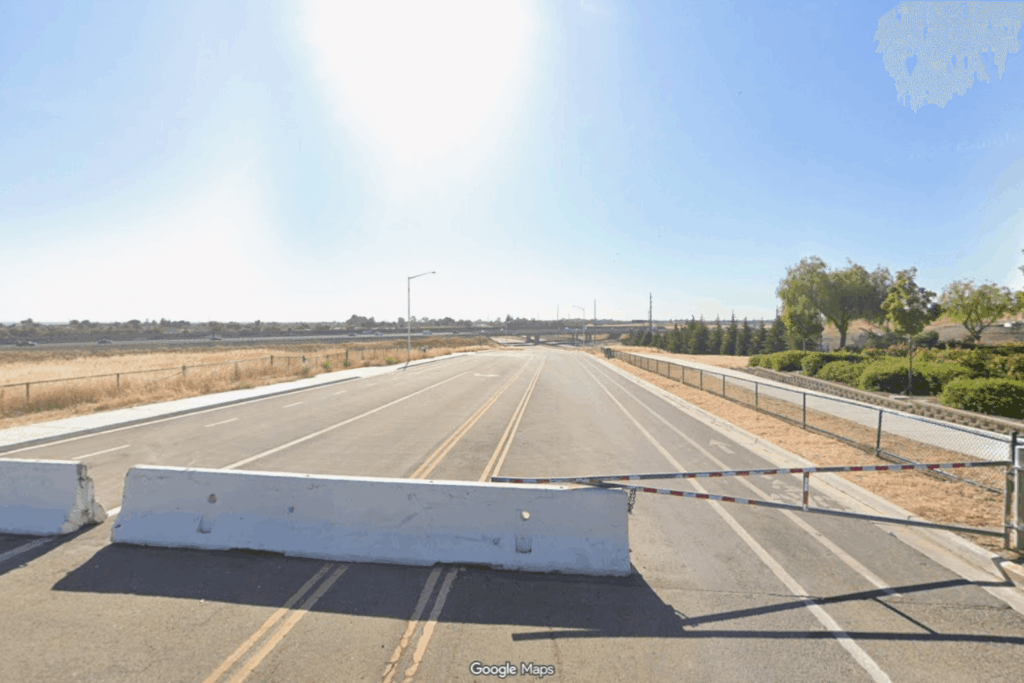
In reality, a bicyclist following that bike lane was injured when it abruptly ended at a locked metal gate and cement barrier blocking the road. According to them, at the time of the crash:
- There were no reflective markings on the gate
- No cones or notice within 100 feet
- And the pavement markings made the bike lane appear fully open
Imagine riding on a dark, seemingly safe corridor — and suddenly meeting a steel gate stretched across your right of way.
Later, reflective tape appeared on the gate.
And that’s when things became strange.
Multiple parties have a role in this roadway: the general contractor, various subcontractors who handled lighting and gate installation, the private developer overseeing portions of the build, and the City of Antioch — including City official John Samuelson, who was responsible for elements of project oversight. Yet not one of them can explain who added the reflective tape, when it was placed there, or why it wasn’t installed before a rider was hurt.
No one will say: “We realized this was dangerous and corrected it.”
Instead, the tape is treated like it just… appeared.
For an injured cyclist in California, that raises real questions. If reflective tape was necessary after the crash, why wasn’t it required before? And if no one will acknowledge adding it now, who — if anyone — is actually watching out for public safety on this long-running road project?
A Dark Road, a Broken Pattern, and a Predictable Outcome
The gate was not the only hazard.
Along this stretch of Antioch roadway, the streetlights were designed to follow a simple zig-zag pattern. For more than a quarter mile, they do exactly that — alternating from one side of the street to the other, maintaining even illumination across the corridor. Look ahead toward the developing section and even a child could predict where the next pole should be.
Except at the gate.
Early construction plans show a light standard originally placed at or near the gate’s location — exactly where a cyclist would need visibility to identify a barrier.
But in the final build, the pattern broke:
- The next lamp post appears to be installed on the wrong side of the street
- The planned location was skipped
- Leaving a dark gap precisely where the gate stood
So the conditions were set: a newly striped bike lane that encouraged riders forward, a locked metal gate placed directly across it, no reflective markings or advance warnings, and missing illumination that should have revealed the hazard.
It’s not hard to understand why a crash occurred.
And this was not a last-minute, slapped-together project. This corridor has been in development since around 2006 — nearly two decades of planning, approvals, construction, and inspections. Yet somehow crews dug a hole, ran conduit, and installed a streetlight on the wrong side of the road while a critical hazard sat in total darkness.
If something this obvious slipped through, residents can’t help but ask:
What else is being missed on our taxpayer dime in Antioch, CA?
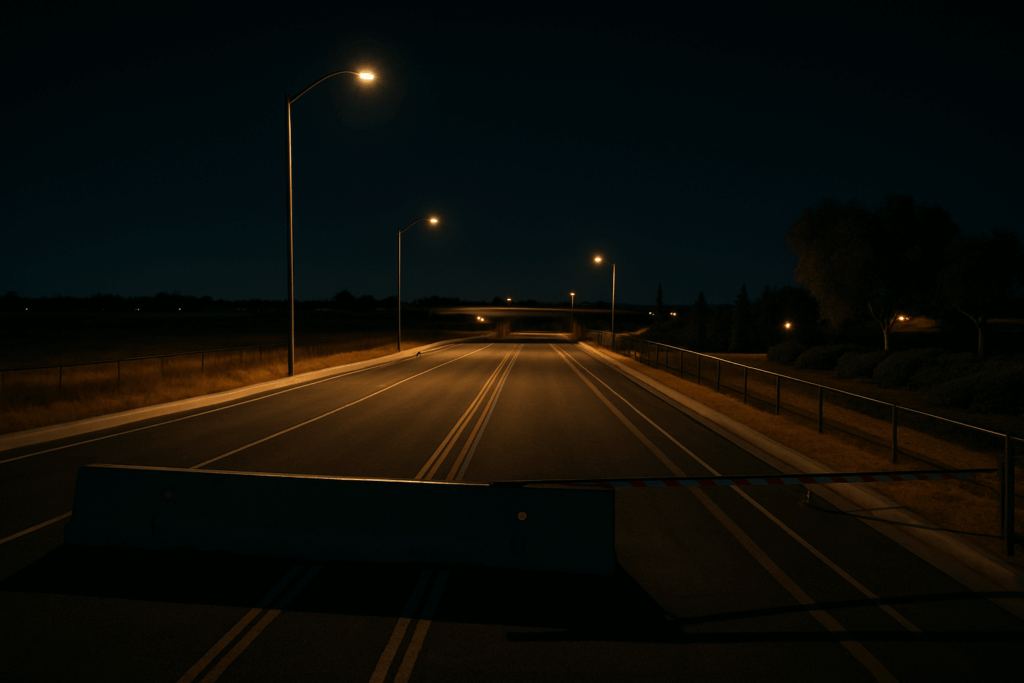
AI-generated nighttime recreation of the roadway based on publicly available Google Earth imagery. This image is for illustrative purposes only and may not reflect the exact lighting, visibility, or conditions at the time of the incident.
Click to contact our personal injury lawyers today
This Isn’t Just Antioch: When Small Oversights Become Serious Crashes
The basics of roadway safety — proper signage, visible barriers, adequate lighting — are not optional. When these “small” details fall through the cracks, the consequences can be catastrophic.
California law agrees. Under state regulations and the CA MUTCD, construction and development zones must be reasonably safe. That includes:
- Correct signage
- Proper barricades
- Advance warnings
- Adequate lighting
When those protections are missing and hazards are hidden or unexpected, agencies and contractors can be held negligent.
Antioch is a textbook example: no sign warning cyclists of a gate ahead, no lighting at the hazard point, and a bike lane that funnels riders directly into an unseen barrier.
A preventable setup for a serious crash.
Complete a Free Case Evaluation form now
Why So Many Hands Mean So Little Accountability
How does something like this happen? Start with the cast of characters common to any public-private road project:
- The City of Antioch
- Former city official John Samuelson, involved in oversight
- The private developer
- The general contractor
- Subcontractors responsible for lighting, gates, fencing, electrical work, and striping
With so many moving parts, each team focuses on its slice of the job. Accountability becomes diffuse. Construction insiders have a name for this dynamic: “the blame game.”
When asked about a problem, every party has an explanation:
“We built what the plans showed.”
“We only handled the electrical.”
“The gate wasn’t our assignment.”
“Talk to the developer about that section.”
“That was a city decision — ask them.”
“There’s nothing more frustrating than asking a basic safety question and being passed around like a bad game of telephone,” says Stephen Lockard, Litigation Attorney at J&Y Law. “When every entity insists someone else is the one with the answers, it’s a sign that no one is actually steering the ship.”
And that’s precisely what appears to be unfolding in Antioch:
- The City may point to the contractor
- The contractor may point to the developer
- The developer may point to a subcontractor
- And the subcontractor may say they followed verbal direction
Meanwhile, an injured cyclist is left with medical bills, pain, and lingering uncertainty about who was supposed to keep the roadway safe.
When Responsibility Becomes a Shell Game
Accountability becomes even harder to trace when multiple companies, DBAs, and subcontractor entities are involved.
It’s common to see:
- Project-specific LLCs
- Contractors working under multiple names
- Subs with limited assets
- Corporate reshuffling over the lifespan of a project
Sometimes these structures are routine. Other times, they operate like a shell game — technically compliant, but practically impossible for a resident or injured party to navigate.
“You see the same pattern over and over,” Lockard adds. “Everyone is technically responsible for a sliver of the job. But when something goes wrong, the entire system turns into a ghost town. Meanwhile, a real person got hurt. And not one entity can explain who put reflective tape on a gate? That’s unacceptable.”
Who Holds Cities and Builders Accountable?
In theory, there are guardrails:
- City inspections
- Performance bonds
- Warranty correction periods
- Contractual enforcement mechanisms
In practice, enforcement is inconsistent — especially on long-term projects with staffing turnover or fragmented oversight.
When problems surface only after a project is accepted, the cost of fixing them often falls on taxpayers… or on injured families.
That’s what makes the Antioch case so troubling. It isn’t just about a missing reflector, a dark roadway, or a bike lane accident. It’s a symptom of a deeper issue:
No one seems clearly accountable for safety decisions that directly affect the public.
What If You’re Hurt in a Bike Lane Accident or Construction Zone?
If you or a loved one is injured in an accident under conditions like these, you’re likely wondering:
Who do I go after?
The city? The developer? The contractor?
What if every party says it’s someone else’s responsibility?
These cases almost always require:
- A deep investigation of plans, emails, inspections, and change orders
- Traffic and lighting experts
- Claims against multiple responsible entities
Public entities may be responsible for approving or accepting the work. Developers for building improvements. Contractors or subs for the immediate hazard — like a mis-installed light or gate.
You shouldn’t be expected to untangle that alone.
J&Y Law regularly handles complex roadway and construction cases involving dangerous bike lanes, invisible hazards, work zones without proper warnings, and defective roadway design.
We identify who had the duty to keep you safe — and hold them accountable.
When a Bike Lane Becomes a Trap, You Deserve Answers
The Antioch situation checks every box of a “how did they let this happen?” moment:
- A long-running project
- A clear safety oversight
- A real person hurt
- A quiet, unexplained “fix” afterward
- And no one stepping up to take responsibility
That should never be acceptable.
If you were injured in a bike lane or construction zone where signage, lighting, or barriers were mishandled, you’re not overreacting by asking tough questions. You’re demanding accountability.
Let us find out who should have kept you safe while you focus on healing.
Call or text (424) 453-2310 or complete a Free Case Evaluation form