
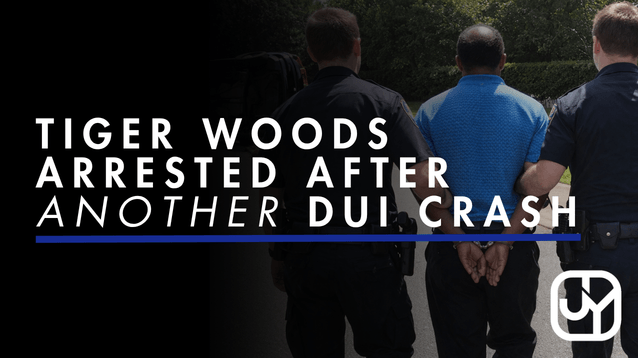
Tiger Woods Arrested After Another DUI Crash

Key Takeaways
- On March 27, 2026, Tiger Woods was arrested on suspicion of DUI after his Land Rover rolled over on Jupiter Island, Florida, near his home.
- Woods was not impaired by alcohol — a breathalyzer registered 0.00 — but authorities believe he was impaired by medication.
- He refused to submit to a urine test and was charged with DUI with property damage and refusal to submit to a lawful test, both misdemeanors under Florida law.
- This is his second DUI arrest (the first was in 2017, also in Jupiter, Florida, also linked to prescription medications) and his fourth high-profile traffic incident since 2009.
- Woods was held for eight hours per Florida law before being released on bail around 11 p.m.
- The crash occurred just three days after Woods made his competitive return in the TGL golf league finals.
What Happened on Jupiter Island
On the afternoon of Friday, March 27, 2026, Tiger Woods was involved in a rollover car crash on Jupiter Island, Florida, just before 2 p.m. ET. A truck pulling a small pressure-cleaning trailer was traveling north and slowing to turn into a driveway when Woods’ Land Rover approached from behind at a high rate of speed. Woods attempted to pass the truck but clipped the back of the trailer, causing the SUV to tip onto the driver’s side and slide along the road before coming to a stop.
Martin County Sheriff John Budensiek said Woods and the person in the other vehicle were not injured. Woods was able to crawl out of the passenger side of his Land Rover. Budensiek noted that the situation could have been far more dangerous, saying that had there been oncoming traffic at the moment of the crash, the outcome would have been very different.
The crash occurred on a two-lane road with a 30 mph speed limit. Budensiek said authorities could not determine how fast Woods was going.
For a free legal consultation, call (877) 735-7035
Signs of Impairment, Not From Alcohol
At the scene, Budensiek said Woods “did exemplify signs of an impairment,” adding that investigators believe he had taken “some type of medication or drug.” Woods agreed to a breathalyzer test that showed no signs of alcohol, but refused a urine test and was arrested.
Woods appeared “lethargic,” according to officials, and tried to explain injuries he sustained from previous accidents. The sheriff described Woods at the time of arrest as “cooperative, but he was not trying to incriminate himself.”
Investigators said they believe impairment may have been caused by medication, though no substances were found in the vehicle. In addition to driving under the influence with property damage, Woods was charged with refusal to submit to a lawful test.
Because Woods declined the urine test, the sheriff said officials will never get “definitive results” about what caused the impairment at the time of the crash.
Woods was held at the Martin County Jail for eight hours, in accordance with Florida law for DUI arrests. He posted bail and left custody at about 11 p.m. Friday. No court date had been set as of this writing.
“Unexpected Reaction to Prescribed Medications”
This is not the first time Tiger Woods has been in this exact situation. In 2017, Woods was found unconscious behind the wheel of his vehicle in Jupiter, Florida. He was charged with a DUI, with toxicology reports revealing the presence of five drugs in his system, including Vicodin, Dilaudid, Xanax, Ambien and THC. Woods pleaded guilty to reckless driving, sentenced to one year of probation while completing a DUI first-offender program.
Following that 2017 incident, Woods issued a statement saying, “I want the public to know that alcohol was not involved. What happened was an unexpected reaction to prescribed medications. I didn’t realize the mix of medications affected me so strongly.” The pattern mirrors the 2026 incident closely: a breathalyzer returning zero, visible impairment at the scene, and a history of prescription drug use tied to years of surgeries and chronic pain.
Click to contact our personal injury lawyers today
A Timeline of Crashes and Consequences
This arrest is the latest chapter in a long and troubling record of traffic incidents. The full picture:
November 2009: A 2:30 a.m. car crash announced the beginning of Woods’ public unraveling, leading to revelations of infidelity and a high-profile divorce. Woods struck a fire hydrant and a tree outside his Florida home.
May 2017: Woods was found asleep behind the wheel of his Mercedes-Benz on a Florida road with the engine running. His toxicology report showed five substances in his system. He was charged with DUI and ultimately pleaded guilty to reckless driving.
February 2021: Woods’ SUV was going 84 to 87 mph in an area with a 45 mph speed limit when it veered off a coastal road in the Los Angeles suburbs, rolled down a hill and struck a tree. He suffered “open fractures” to his lower right leg, had a rod placed in a tibia, and had screws and pins inserted in his foot and ankle during emergency surgery. Woods was hospitalized for three weeks. He was not charged; then-L.A. County Sheriff Alex Villanueva called the crash a total accident and said there was “no evidence of impairment,” though the decision not to test his blood drew criticism.
March 27, 2026: The Jupiter Island rollover, his second DUI arrest and fourth major crash.
Complete a Free Case Evaluation form now
Career on Life Support
Recovery from the 2021 crash took years and included at least two additional surgeries. In 2025, he suffered a ruptured Achilles tendon while attempting to come back from a 2024 back surgery, and in late 2025 he had yet another procedure on his back.
Woods has played just 11 tournaments in the five years since the 2021 crash. Of the four times he finished 72 holes, he has not finished within 16 shots of the winner. Earlier this week, he had said: “This body, it doesn’t recover like it did when it was 24, 25.”
He had been weighing whether to compete at the Masters beginning April 9, and was also days away from a decision on whether to accept the role of U.S. Ryder Cup captain for the 2027 matches in Ireland. He also serves as chairman of the PGA Tour’s Future Competition Committee, which is in the process of reshaping the tour’s structure. All of that is now on hold.
Three days before the crash, Woods made his competitive return participating in the TGL championship with the Jupiter Links team he captains. Viewership spiked to nearly 1 million — the second-highest rating behind his TGL debut.
Drugged Driving Is Drunk Driving Under the Law
Tiger Woods’ story is extraordinary in its details, but the legal principle at its center is one that personal injury attorneys deal with in ordinary cases every day: a driver does not need to be drunk to be impaired, and impaired driving kills and injures people regardless of which substance caused it.
Under Florida law — and the laws of every U.S. state — driving under the influence of prescription medication is treated the same as driving under the influence of alcohol. A driver who takes legally prescribed medications and then operates a vehicle in a way that impairs their ability to do so safely can be held both criminally and civilly liable for any harm that results.
In Woods’ 2026 crash, no one was seriously hurt. But consider the sheriff’s own words: had there been oncoming traffic, the conversation about injuries would have been very different. When impaired driving does injure another person — a driver, a passenger, a pedestrian, a cyclist — that victim has legal recourse.
In a personal injury case involving a driver impaired by medication, an injured victim can typically pursue compensation for medical bills, lost wages, pain and suffering, and other damages. The fact that a driver’s impairment came from a prescribed medication rather than illegal drugs or alcohol does not shield them from civil liability. Evidence such as toxicology reports, dashcam footage, witness testimony, and the arresting officer’s observations can all be used to establish that the at-fault driver was not fit to be behind the wheel.
Woods’ 2017 case is instructive on this point. Toxicology confirmed five substances in his system. A urine test refusal in the 2026 incident means those definitive results may never exist in the criminal case — but in a civil case, that refusal itself can be introduced as evidence, and the totality of observable impairment at the scene still matters.
If you or a family member has been injured by a driver who was impaired by medication, alcohol, or any other substance, you deserve a thorough legal evaluation of your options. At J&Y Law, our car accident attorneys have experience handling cases involving all forms of impaired driving. Contact us for a free consultation.
This article is for informational purposes only and does not constitute legal advice.
Call or text (877) 735-7035 or complete a Free Case Evaluation form