
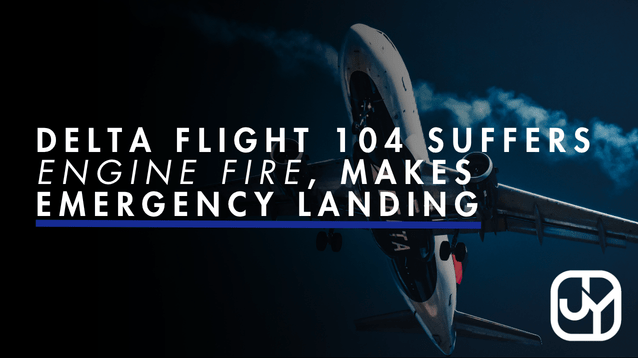
Delta Flight 104 Suffers Engine Fire, Makes Emergency Landing

On March 29, 2026, Delta Flight 104 climbed out of São Paulo’s Guarulhos International Airport and within seconds was on fire. The left engine of the Airbus A330-323 failed in a cascade of explosions and visible flames, dropping burning debris onto the runway below, while 286 people on board had no way of knowing whether the aircraft would hold together long enough to land. It did — roughly 10 minutes later. Delta issued a statement referencing a “mechanical issue with the aircraft’s left engine” and confirmed that all customers were safe.
The statement doesn’t address what the passengers on that plane actually lived through, and what legal options exist for those who have been affected. At J&Y Law, we are currently representing passengers injured in the United Airlines Flight 2127 engine fire at LAX on March 2, 2026. If you were on Delta Flight 104, your situation warrants the same level of legal attention.
What Happened on Delta Flight 104
Delta Flight 104 departed Guarulhos International Airport in São Paulo, Brazil, on the evening of March 29, 2026, operating a scheduled service to Hartsfield-Jackson Atlanta International Airport. The aircraft — an Airbus A330-323, registered N813NW, equipped with Pratt & Whitney PW4000 engines and delivered in 2006 — carried 272 passengers and 14 crew members.
Seconds after the main landing gear left the runway, the left engine suffered what aviation analysts later described as a severe compressor stall: a violent disruption of airflow through the engine core that, in this case, produced audible explosions and sustained fire. Burning material detached from the engine and fell to the grass beside the runway, igniting a brush fire within the airport perimeter. Local air traffic controllers radioed the crew directly: “You have fire on your wing.”
The pilots stopped the climb at approximately 4,500 feet, shut down the left engine, and turned back. The aircraft landed at Guarulhos roughly 10 minutes after departure. Airport rescue and firefighting teams met the plane on the ground. Passengers were transported to the terminal by bus.
Delta confirmed that all passengers and crew were accounted for and that no injuries were recorded. However, United Airlines also reported no injuries on flight 2127, but we are representing passengers from that flight for injuries and severe emotional distress.
For a free legal consultation, call (877) 735-7035
Understand What Passengers Experienced in the Cabin
The official outcome was a safe landing. What passengers described was something they could not have been certain would happen while it was unfolding.
Multiple videos recorded inside the cabin and posted to social media show sustained flames trailing from the left engine as the aircraft climbed away from the runway. In footage captured from window seats on the left side of the aircraft, the fire is visible for an extended period before the plane begins its return. Passengers can be heard screaming and praying. One passenger told reporters afterward: “I felt a lot of panic, just panic. Fear, fear of dying — you see the plane catching fire, you know, what are you going to think?” Another said: “I’ve never experienced such despair in my life,” describing “a real fear of dying.”
For the roughly 10 minutes that Flight 104 was airborne with a burning engine and falling debris, the 286 people on board had no visibility into whether the aircraft was structurally sound or whether the fire was contained. Trauma is determined by what a person believed was happening to them in the moment, not by how the event resolved. Watching fire pour from an engine at altitude, with no information and no exit, clears the clinical threshold for acute traumatic stress regardless of the landing that followed.
Post-traumatic stress disorder, generalized anxiety disorder, and a clinically significant phobia of flying are recognized psychiatric conditions that can develop from a single acute event. Each can affect sleep, daily functioning, and the ability to work. Critically, PTSD symptoms frequently do not emerge until weeks or months after the triggering incident — meaning a passenger who feels functional today may be experiencing delayed onset trauma responses in the weeks ahead. Documenting symptoms now, including through visits to a physician or mental health professional, creates a contemporaneous record that carries significant evidentiary weight if a legal claim is later filed.
How the Montreal Convention Applies to This Flight
Because Delta Flight 104 operated between Brazil and the United States, it falls under the Montreal Convention of 1999 — the international treaty governing liability for passengers on international commercial flights. Both Brazil and the United States are signatories.
Under Article 17 of the Montreal Convention, an airline carrier is strictly liable for passenger injuries up to approximately 128,821 Special Drawing Rights (SDR), which converts to roughly $170,000 USD at current exchange rates. Strict liability means Delta does not get to dispute fault below that threshold — the obligation to compensate attaches automatically if a passenger can demonstrate injury. Above the threshold, the carrier bears the burden of proving it was not at fault, or that the injury resulted solely from a third party’s actions.
The central legal question for passengers who suffered psychological harm but no documented physical injury is whether that harm constitutes “bodily injury” under Article 17. U.S. courts have reached divergent conclusions on this. Passengers who experienced physical manifestations of their psychological distress — accelerated heart rate events requiring medical attention, hyperventilation, vomiting, or any physical injury sustained during the emergency — have a clearer path to recovery under the treaty’s strict liability provisions. Passengers who have since received a psychiatric diagnosis — PTSD, acute stress disorder, anxiety disorder — directly linked to the incident also have viable claims.
One procedural detail passengers should know: the Montreal Convention imposes a two-year statute of limitations from the date of the incident. That deadline is March 29, 2028. The practical argument for acting sooner rather than later is straightforward — psychological symptoms documented close in time to the incident are harder for a carrier to attribute to other causes.
Click to contact our personal injury lawyers today
How Airlines Manage Claims After Incidents Like This
Following a major aviation incident, airlines and their insurers typically initiate contact with passengers quickly. Early outreach is not goodwill — it is claims management.
Settlement offers made in the days or weeks after an incident are reliably lower than what a represented passenger could recover through litigation or structured negotiation. Passengers who accept early offers and sign the accompanying release — which those offers almost always require — permanently waive any further legal rights, including the right to seek compensation for conditions that develop or worsen after the release is signed. This is a legally binding trade executed at the moment a passenger has the least information about the actual value of their claim.
Delta has not publicly disclosed its approach to claims from Flight 104 passengers. What is known is that a left-engine fire on an international flight, producing visible flames, falling debris, and a documented emergency response, falls squarely within the categories of event that have generated successful passenger claims under the Montreal Convention. The real-time video footage and passenger statements published across major news outlets establish a substantial factual record.
If Delta or any representative of its insurer contacts you about the incident, do not agree to anything or sign any document before speaking with an attorney. Even a preliminary conversation — without any commitment — will give you a clearer picture of what you may be giving up.
Complete a Free Case Evaluation form now
United Airlines Case J&Y Law Is Actively Litigating
On March 2, 2026, United Airlines Flight 2127 — a Boeing 787-9 Dreamliner with 256 passengers and 12 crew — departed LAX bound for Newark when the crew received fire alarms from the left engine approximately 36 minutes after takeoff. The pilots shut down the engine, returned to LAX, and ordered an emergency evacuation via deployed slides while fire crews responded on the tarmac.
United reported no injuries requiring hospitalization. J&Y Law is currently representing passengers injured in that incident — people who sustained physical injuries during the evacuation itself, and people who experienced documented psychological harm from the event. The critical legal finding in that case, as in others like it, is that an airline’s statement that no one was “seriously injured” does not mean passengers lack compensable claims.
The Delta Flight 104 incident shares the same structural facts: a left engine fire on a commercial aircraft, an emergency return, passengers who witnessed fire from their seats and believed they might not survive, and an airline communication that emphasized the safe outcome while leaving the psychological dimension of the incident unaddressed. Our airplane accident lawyers have also handled claims arising from other airline incidents involving passenger trauma and physical harm, including turbulence injuries and emergency landings governed by the Montreal Convention. The legal framework applicable to those cases applies to this one.
Contact J&Y Law If You Were on Delta Flight 104
J&Y Law represents personal injury clients throughout California, including passengers injured physically or psychologically in aviation incidents on domestic and international flights. Every case we take is on a contingency fee basis — no retainer, no hourly fees, no upfront costs. You pay nothing unless we recover for you.
If you were on Delta Flight 104 on March 29, 2026, and you have experienced anxiety, nightmares, difficulty sleeping, a reluctance to fly, or any physical symptoms you connect to what happened on that flight, speak with an attorney before you have any further communication with Delta or its representatives.
Call (877) 735-7035 or contact us online for a free consultation.
Call or text (877) 735-7035 or complete a Free Case Evaluation form
